
Notified isn't contracted: how Foreign Military Sales actually work
A notification is a ceiling that lets the U.S. offer a sale; the money that moves is what later shows up as FMS funds obligated in DoD contract announcements.
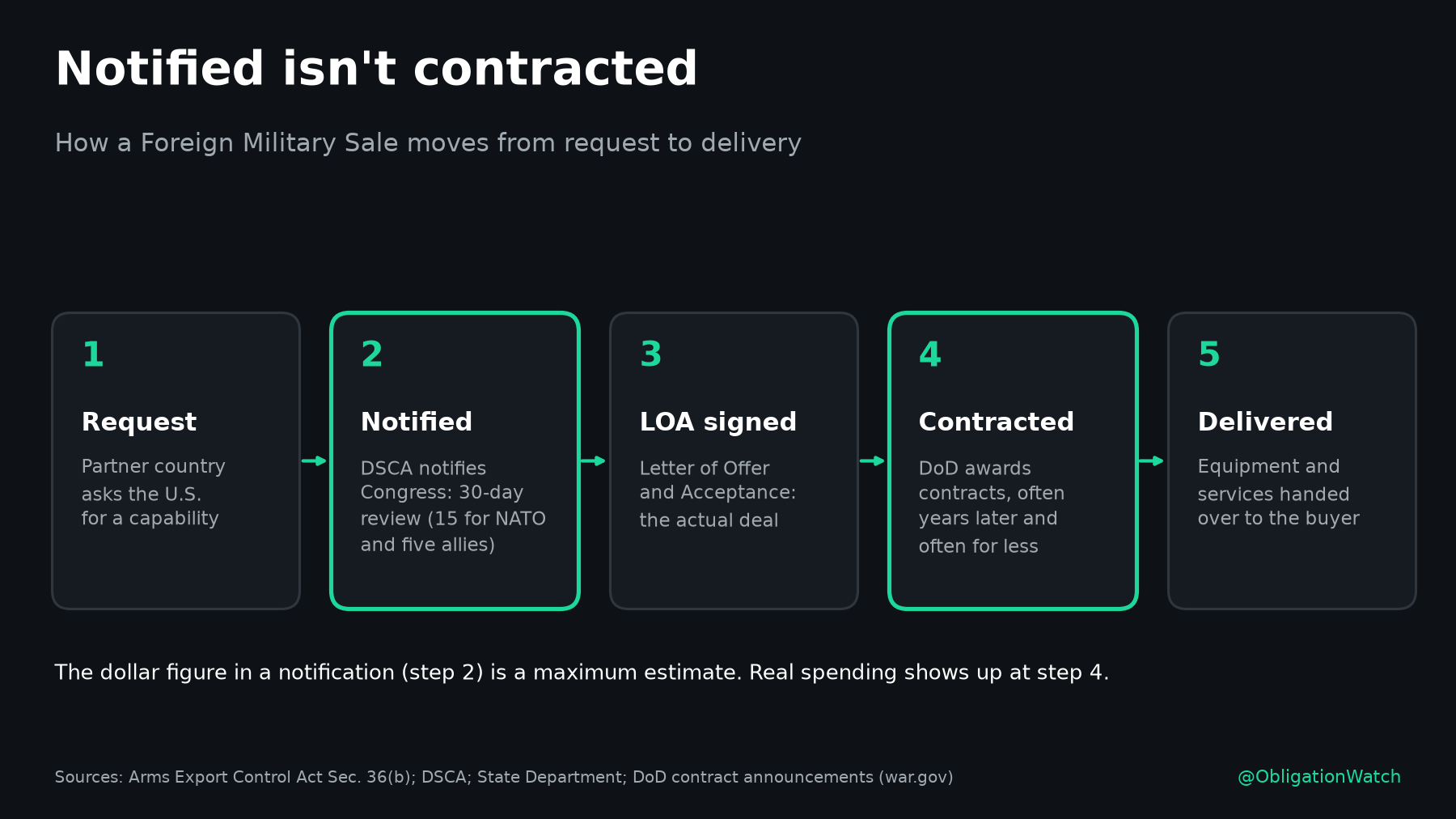
When a headline says the U.S. "approved" a multibillion-dollar arms sale, it usually refers to a notification to Congress, not a signed deal or a contract. The notified figure assumes the buyer purchases everything listed, so it is the most a sale could be worth. The money that actually moves shows up later, often years later, in Pentagon contract announcements. (Some "approved" headlines instead refer to Direct Commercial Sales export licenses under Section 36(c), company-to-government deals licensed by the State Department; those aren't covered here.)
Source: Arms Export Control Act Sec. 36(c) (22 U.S.C. 2776); Congressional Research Service, "Transfer of Defense Articles: Direct Commercial Sales"
What Foreign Military Sales are
Foreign Military Sales (FMS) is the government-to-government channel for selling U.S. defense equipment, training, and services to other countries and international organizations. The buyer signs with the U.S. government, not a company, and the Department of Defense then buys from contractors as it does for U.S. forces. The Defense Security Cooperation Agency (DSCA) runs it under State Department policy approval and the Arms Export Control Act.
Source: DSCA; Arms Export Control Act (22 U.S.C. 2751 and following)
Step 1: A country asks
It starts with a Letter of Request from the partner country describing what it wants. U.S. officials help define the package and estimate its cost. Much of this happens before anything is public.
Source: DSCA Security Assistance Management Manual
Step 2: Congress is notified
Under Section 36(b) of the Arms Export Control Act, larger proposed sales must be formally notified to Congress before the U.S. can offer them, with thresholds that depend on the buyer and type of sale ($14 million for major defense equipment, $50 million for defense articles or services, and $200 million for design and construction services for most countries; $25 million, $100 million, and $300 million for NATO members, Japan, Australia, South Korea, Israel, and New Zealand). Most multibillion-dollar notices in headlines clear these thresholds easily.
Once the formal notice is sent, a review period begins: 30 calendar days in general, or 15 days for NATO members and those five countries. Congress can try to block a sale by passing a joint resolution of disapproval, but the President can veto it, and overriding a veto takes two-thirds of both chambers. Congress has never blocked a sale this way; the closest was a 1986 Saudi package, where a veto was sustained after Stinger missiles were dropped.
The statute also allows review to be skipped entirely if an emergency is declared. This was done for sales to Saudi Arabia and the United Arab Emirates in May 2019 and for tank and artillery ammunition for Israel in December 2023.
DSCA and the State Department post each formal notice; most news coverage is based on these.
Source: Arms Export Control Act Sec. 36(b) (22 U.S.C. 2776); Congressional Research Service, "Arms Sales: Congressional Review Process"; Congressional Record, June 4, 2019 (Saudi Arabia/UAE emergency determination); DSCA Major Arms Sales; State Department
Why the notified figure is a maximum, not a sale
The notified amount is not a price, a signed deal, or money obligated to a company. Several things can shrink it, delay it, or stop it:
- The buyer may choose a smaller quantity or drop items.
- Negotiations on the offer can lower the price.
- The buyer may buy elsewhere or not proceed at all.
- Pieces are often bought over many years, in separate contracts.
A notice for "up to" a figure is permission to offer up to that amount, not a sale of it.
Source: DSCA Major Arms Sales; DSCA Security Assistance Management Manual
Step 3: The Letter of Offer and Acceptance
After the review period, the U.S. can present a Letter of Offer and Acceptance (LOA). This is the actual agreement, listing items, estimated cost, payments, and terms. The sale becomes real when the buyer signs the LOA and makes its initial deposit. LOA values are not routinely published the way notifications are.
Source: DSCA Security Assistance Management Manual
Step 4: The contracts
With a signed LOA and money in hand, DoD awards or modifies contracts to cover the foreign customer's share. DoD's daily contract announcements now post at war.gov, under the "Department of War" secondary name authorized by a September 2025 executive order. They typically include a line such as "Foreign Military Sales funds in the amount of $X will be obligated at the time of award." Money obligated at award is legally committed but not necessarily paid out yet; that's the figure we focus on.
Three examples from last week (figures as published; the first two were not competitively procured, meaning they were awarded without competition):
- Oct. 27: Lockheed Martin ($LMT, @LockheedMartin) received a $9,755,583 contract for updated electronic-warfare and radar warning software for Canada's CH-148 Cyclone helicopter fleet. The full $9,755,583 is Foreign Military Sales funds, obligated at award. (Naval Air Systems Command)
- Oct. 28: Boeing ($BA, @BoeingDefense) received an $11,144,746 modification for F/A-18 instructor-pilot and ground-training services for the Kuwait Air Force. All $11,144,746 is FMS customer funds, obligated at award. (Naval Air Warfare Center Training Systems Division)
- Oct. 29: Boeing received a contract with a maximum value of $31,911,362 for three years of C-17 logistics support for the NATO Airlift Management Programme at Papa Air Base, Hungary. Of that, $23,348,054 in FMS funds was obligated at award, so the obligated amount is less than the ceiling. (Air Force Life Cycle Management Center)
Also common: FMS money alongside other money on one contract. On Oct. 29, RTX's Pratt & Whitney ($RTX, @RTX_News) received a $32,181,162 option on F135 engine sustainment for the F-35, funded by Air Force, Navy, and Marine Corps operations funds; $5,738,624 from F-35 cooperative program partners; and $4,211,762 in FMS customer funds. The partners (the UK, Italy, the Netherlands, Canada, Australia, Denmark, and Norway) take part in the program under a joint agreement with the U.S. and pay through that partnership. Other F-35 buyers, such as Japan and Poland, purchase through FMS.
We couldn't verify a link between any of these contracts and a specific congressional notification from official sources, so we haven't drawn one. Announcements usually don't cite the notification number.
Source: DoD contract announcements, Oct. 27, 28, and 29, 2026 (war.gov); F-35 Joint Program Office; Lockheed Martin F-35 program site; White House executive order, Sept. 5, 2025
Step 5: Delivery
Equipment is built, tested, and handed over, often in batches over several years. Many cases stay open for years afterward for spare parts and sustainment.
Source: DSCA
How to follow a sale from notice to contract
- Start with the notice on DSCA's Major Arms Sales page and note the country, the system, and the "up to" estimate.
- Watch DoD contract announcements for that country or program name alongside "Foreign Military Sales." The amount obligated at award is the committed figure; a "maximum" or ceiling value is not.
- Be patient. The lag from notification to the first obligated contract can be months to years, so not finding a matching contract soon is normal and doesn't mean the notice was wrong.
- Check USAspending (@usaspending) using the contract number to see obligations over time.
- Add it up with care. One notification can lead to many contracts, and one contract can serve several countries, so totals rarely match one-to-one.
Source: DSCA; DoD contract announcements; USAspending.gov
How @ObligationWatch labels these
ObligationWatch reports the obligated amount and flags when a larger number is only a ceiling.
- Notified: a proposed sale sent to Congress. The figure is a maximum, not committed money.
- Contracted: a DoD award or modification that cites FMS funds, reported at the amount obligated at award.
Both labels are descriptive. We don't take a position on any sale or any country.
Follow @ObligationWatch for weekday posts on new federal awards and the Friday Top 10.
Sources
- DSCA, Major Arms Sales
- DSCA, Security Assistance Management Manual
- State Department, Arms Sales Congressional Notifications
- Arms Export Control Act Sec. 36, 22 U.S.C. 2776
- Congressional Research Service, Arms Sales: Congressional Review Process (RL31675)
- Congressional Research Service, Direct Commercial Sales (IF11441)
- Congressional Record, June 4, 2019, S3203 (Saudi Arabia/UAE emergency determination)
- F-35 Joint Program Office, partners
- Lockheed Martin, About the F-35 (partners and FMS customers)
- White House, Restoring the United States Department of War (Sept. 5, 2025)
- DoD contracts, Oct. 27, 2026
- DoD contracts, Oct. 28, 2026
- DoD contracts, Oct. 29, 2026
- USAspending